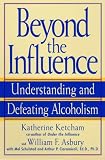
The authors here perpetuate the confusion that has existed all along about alcoholism, even while claiming science on their side.
Only a born alcoholic can be an alcoholic, is the strong claim on page 5.
But they go on to say that behavioral tests are still the most reliable way to predict alcoholism (p. 112). The problem is that the tests that they administer will create a "positive" for almost anyone who drinks regularly. "Problem drinkers" will certainly score high on these behavioral tests. But the authors are at pains to say that many, if not a majority, of "problem drinkers" are NOT alcoholics (p. 105). In my view, "problem drinkers," with their outrageous misbehaviors, are more likely to be thought of as alcoholics than true born alcoholics who are operating in the "high-function" area between early- and middle-stage alcoholism. Although many "problem drinkers" are alcoholics, not all alcoholics present themselves as "problem drinkers." The tests would mistakenly nail the one group, and also mistakenly miss the other. Are you confused? If you're not, then you haven't been paying attention.
For me, the clarity cited in my review title comes from reading Ketcham's earlier book, "Under the Influence." It was a huge light bulb that came on in reading the descriptions of acetaldehyde in our bodies. In Milam and Ketcham's description, the distinction between the born alcoholic and the non-alcoholic centered on how early (after the first drink) acetaldehyde appeared in the bloodstream, and how long it persisted there. Born alcoholics generated more acetaldehyde in their systems more quickly, and they evacuated it more slowly. If the persistent presence of acetaldehyde in the system (with its attendant metabolic transformations) is the primary thing that leads to alcohol addiction, then that leads to an inescapable conclusion... eventually, anyone that drinks long enough and hard enough will exceed his or her ability to efficiently evacuate acetaldehyde from their system... eventually, if you drink long enough and hard enough, acetaldehyde will be present in your system, and you'll subject yourself to its addiction-causing effects... eventually, you'll become an alcoholic.
This would explain delayed-onset alcoholism. A truly "born" alcoholic could become irretrievably lost after a few short years of problem drinking. But a "problem drinker" who is not born to alcoholism might drink heavily for 20 years, give up without difficulty for a whole year (impossible if you're middle-stage or later), return to 20 years of hard drinking and finally, in retirement, be diagnosed as a late-stage alcoholic. I've seen any number of cases of this long-onset alcoholism, and it's always been puzzling, but the acetaldehyde model explains it quite well.
The inescapable conclusion of reading between the lines of "Under the Influence" was that ANYONE CAN BECOME AN ALCOHOLIC.
That conclusion is supported by the behavioral tests in "Beyond the Influence," but we're still left with the insistent claim that many "problem drinkers" will not become alcoholic, even if they continue heavy drinking throughout their adult lives, and that the distinction is black and white.
So which is it? The only reason I'm not confused is because I believe what I've read in "Under the Influence," and I believe that ANYONE CAN BECOME AN ALCOHOLIC. It may take 40 years for the full symptoms to appear, but if you abuse for long enough they WILL appear, and you WILL be an alcoholic... all you have to do is the acetaldehyde math. It's also clear that if you stay below your acetaldehyde evacuation threshold, you can stay out of trouble, but that the acetaldehyde evacuation threshold isn't that high for most of us (the problem is that we don't have reliable ways of determining our acetaldehyde evacuation threshold). That's what I believe. It's as clear as a bell, which is more than can be said for "Beyond the Influence."
"Beyond the Influence" almost seems like it pre-dates "Under the Influence." It features less science and more behavior. "Beyond the Influence" should have benefited from almost 20 years of hindsight and improved technology. Instead, the lines are fuzzier, not clearer.
Oh, and one last thing. Ketchams's been right all along about one thing. However you got there, if you're an alcoholic, once you're there, it's definitely physiological.
Buy it here now!
Friday, July 3, 2009
Beyond the Influence: Understanding and Defeating Alcoholism Review
Posted by Alfred at 6:19 PM
Subscribe to:
Post Comments (Atom)
0 comments:
Post a Comment